Build carbon capabilities early and secure a leading position in the international market.
How traditional small and medium-sized enterprises can leverage carbon management to create an order‑winning advantage.
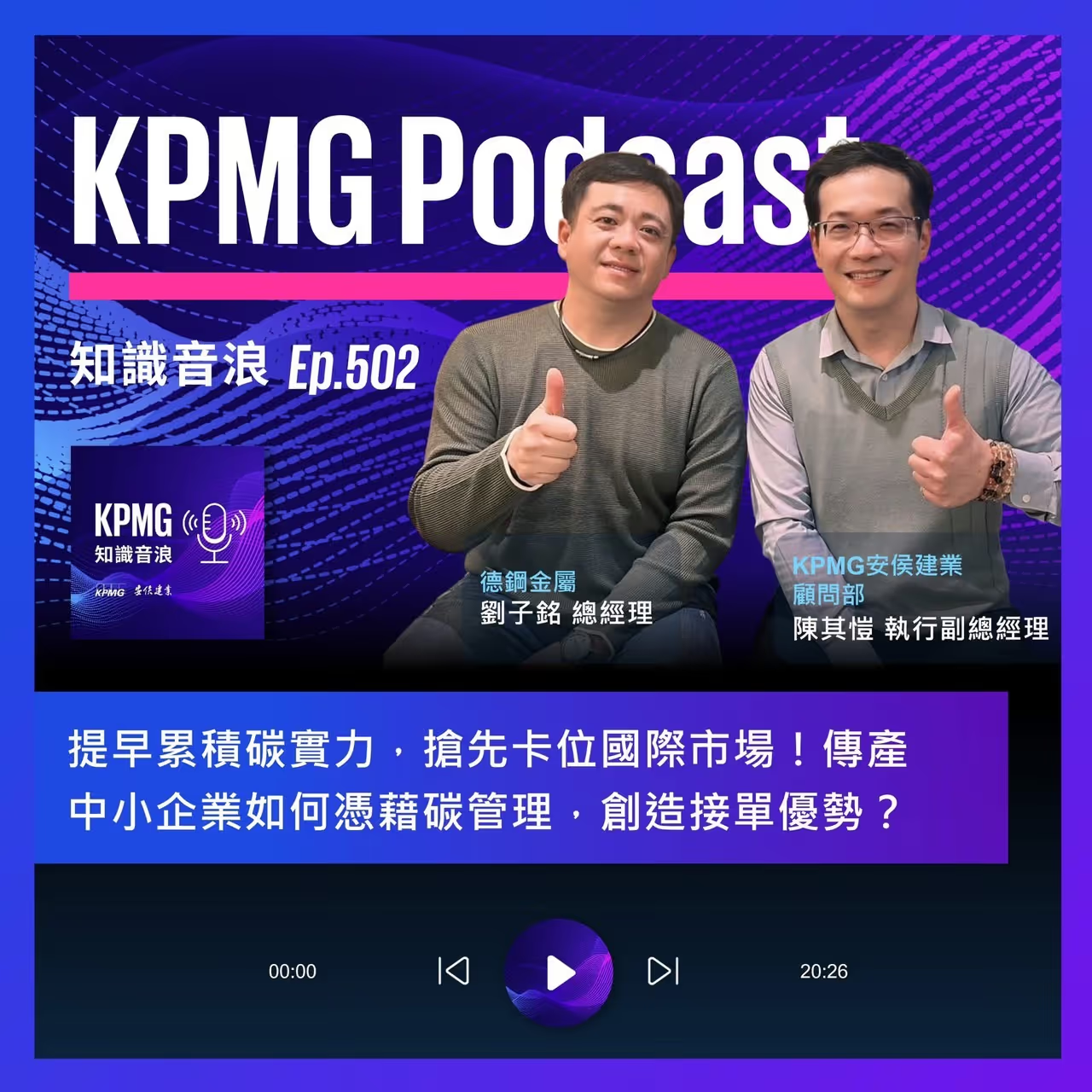
KPMG Knowledge Waves – Interview with Inter‑Tech Metalworks General Manager Liu

KPMG (KPMG Taiwan) invited Inter‑Tech Metalworks General Manager Liu to its podcast to share how traditional industries can turn “carbon anxiety” into a “competitive advantage.”Inter‑Tech Metalworks has transformed from traditional laser cutting and sheet metal processing into green energy construction and semiconductor equipment, becoming a benchmark for green transition among small and medium‑sized enterprises.
Core topic: Carbon management has changed from an “elective course” to a “battle for survival”
In today’s international trade, a product’s “carbon content” has become the third key indicator after cost, quality, and delivery time. For SMEs, carbon data is no longer just an environmental issue but a real trade barrier. If they cannot provide accurate carbon emission data, they will face the following risks:
Loss of orders: To achieve net‑zero targets, major customers will first eliminate suppliers that cannot cooperate with data disclosure.
Loss of price competitiveness: If the data is not precise enough, companies may be charged higher carbon taxes when filing under the EU Carbon Border Adjustment Mechanism (CBAM), directly eroding gross margins.
Transformation in practice: Deep integration of digitalization and carbon management.
Inter‑Tech Metalworks is not passively coping with inspections but taking the initiative to build a professional brand image through digitalization:
Management revolution: With professional consulting, they revamped the ERP system and embedded “carbon factors” directly into management logic, helping employees understand the link between each kilowatt‑hour, every material loss, and cost.
Data automation: Inter‑Tech can disclose a product’s carbon footprint at the moment the product is shipped or the drawing is generated. This level of detail even surpasses many large electronics manufacturers, allowing them to provide data within an hour or at the time of shipment.
Production traceability: By integrating digital management systems, Inter‑Tech can trace a product’s production down to the year, month, minute, and second, and quickly locate the source when anomalies occur to report back to customers, significantly boosting trust in product quality.
Competitive advantage: Upgrading from a parts supplier to a “sustainability partner”.
The key to Inter‑Tech Metalworks’ success lies in turning its “carbon capabilities” into a driver for winning orders.
Saving costs for customers: By directly providing calculated Scope 3 data, they help customers save weeks of data exchange, labor costs, and external verification fees.
Attracting new customers: Many new clients approach Inter‑Tech because of its “data automation services”, turning it from a simple parts supplier into an indispensable “sustainability partner”.
Transformation advice for small and medium‑sized enterprises.
Liu offers three suggestions for peers facing carbon anxiety:
Mindset shift: Carbon management is not merely a cost, but a necessary investment in future operating capability and competitiveness.
Make good use of external expertise: With limited resources, SMEs should seek professional consulting teams to benchmark against international standards and reduce the cost of trial and error.
Phase it in with digitalization first: Do not aim for one‑step completion. Start with ISO 14064 (greenhouse gas inventory) to understand emission sources, then extend to ISO 14067 (product carbon footprint). At the same time, promote digitalization, replacing manual forms with system automation for long‑term, precise management.


.avif)

.avif)